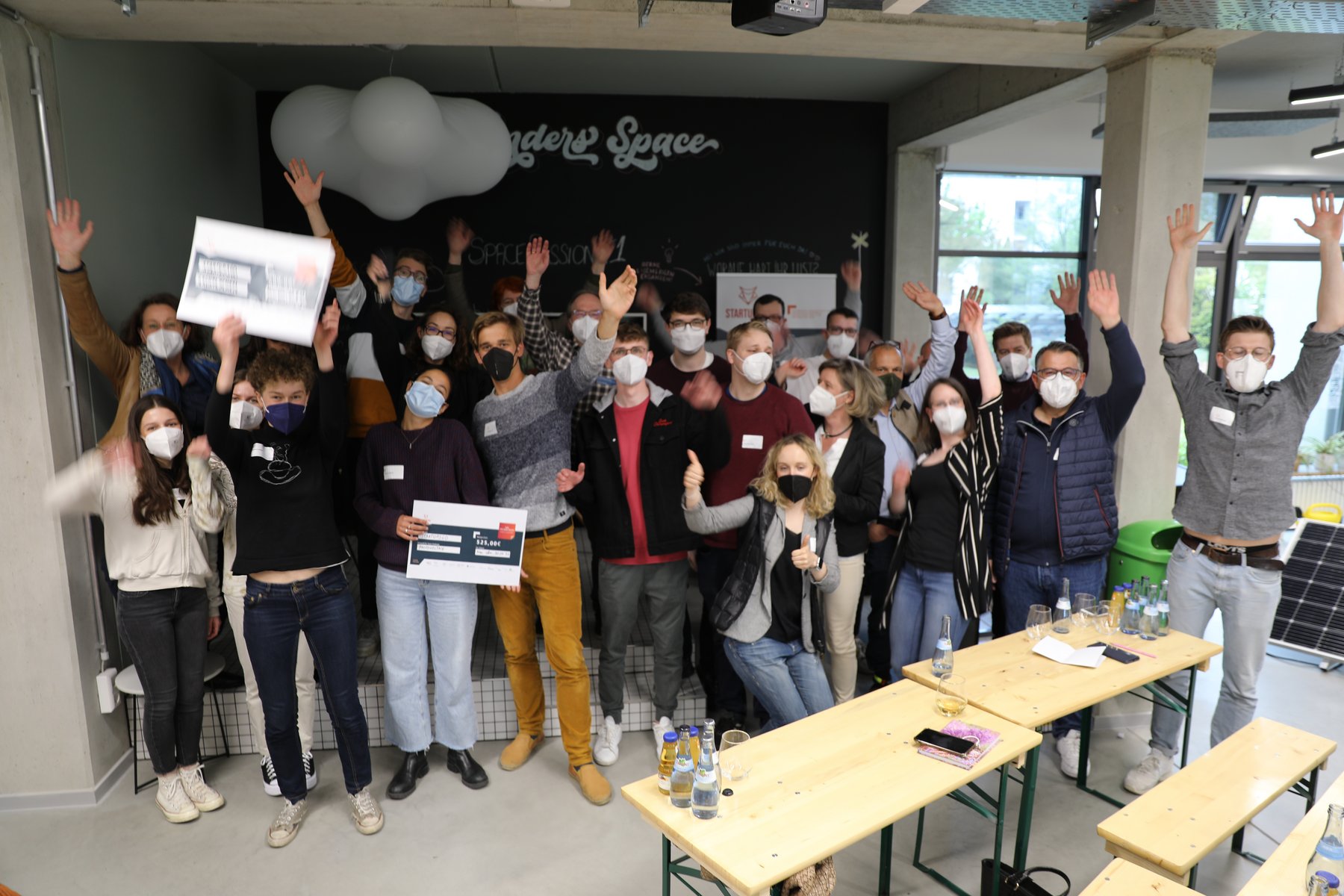
The participating students worked in four groups on a question, or so-called "challenge", submitted by the partners - the cities of Neu-Ulm, Ulm and Biberach and the Haus der Nachhaltigkeit e.V.. The topics were:
How do we manage to increase the acceptance and use of plug-in photovoltaic balcony modules among citizens of Ulm?
Which analog or digital offers can be used to promote the topic of "fair trade" in Neu-Ulm?
How can we inspire citizens to become sustainably involved in the design of green spaces?
How can we create a cooperation network with actors in the region in the field of upcycling & circular economy?
Using the Design Thinking method to develop sustainable ideas
Using design thinking, the participants tinkered with individual problems. Design thinking is a method for developing user-oriented solutions based on structured processes. To begin, students defined their challenge or problem, interviewed typical users, tested existing solutions, and built expertise to gain a better understanding of the initial situation. In the next step, the participants themselves took on the role of the user and visualized the needs, thoughts and feelings of potential users with regard to a specific product or service with the help of user empathy maps and user journeys. Finally, the teams applied creativity techniques to generate ideas to meet the previously identified needs. These ideas were then prototyped in the form of sketches, models, a story and a film.
The participants were supervised by StartupSÜD coaches Hannes Metzger, Dana Schultchen, Marcel Moser, Valerie Pabst, Antonia Hanesch, Carina Volk and Linda Mühlbach. Prof. Daniel Schallmo accompanied the content-related methodological part of the design thinking process.
The project concluded on Saturday afternoon with the presentation of the results and the awarding of prizes to the best team. All teams successfully mastered the challenge and developed creative ideas to their problem.
The results from 24 hours and the winning team
The prize money was sponsored by the practical partners of the cities of Neu-Ulm, Ulm and Biberach. All participants also received a voucher for a workshop with the Haus der Nachhaltigkeit e.V. (House of Sustainability).
The team that won was the challenge for the green space design of the city of Biberach. The students were able to convince the jury of their idea and received 600 euros in prize money. A sponsorship concept with an interactive green space map was presented as a way for citizens to participate in the sustainable maintenance and design of green spaces in public areas.
With the slogan "Your balcony, your electricity", the Photovoltaic Challenge team designed an advertising campaign to increase the acceptance and use of plug-in photovoltaic balcony modules for the city of Ulm. The team was particularly convincing with creative social media content and the citizen-centric approach of its campaign.
For the Fair Trade Challenge of the city of Neu-Ulm, the team developed a prototype for a platform called MIRI, which aims to create more visibility and transparency for fair trade products in the region. The approach not only offers a store, but also the possibility for citizens to get socially involved in the MIRI association.
As part of their challenge from the Haus der Nachhaltigkeit e.V., the circular economy team developed an online portal as a solution for the repair of small appliances. Users can obtain an initial digital assessment of the possibility of a repair in advance, book rental equipment for the duration of the repair, and exchange information about repair communities.
24 hours are over, the ideas and experiences remain
The combination of methodical idea development and practical, real-world challenges coupled with the creative energy of the students produced compelling results at this Makeathon.
One participant describes how she personally developed: "For me, the main motivation was to get out of my comfort zone, contribute my ideas and actually dare to present them."
Nathalie Musto, jury member and mentor from the city of Biberach, is pleased with the results: "I would never have thought that within 24 hours you could find solutions from these topics that are sustainable on the one hand, but also implementable, fundable and transferable to other cities."
Feedback from the practice partners was very positive, and efforts are already underway to continue working with the students to advance the ideas after the event.
"The students quickly got to grips with the methodology and achieved very valuable results within the framework of the application - I am thrilled every time to see the dynamics that are created in the teams," says Daniel Schallmo, who used elements of the specially developed approach as part of the Makeathon.
After a successful launch of the new StartupSÜD format "24h for your region", a continuation is planned for the coming year. The focus topic and the practice partners will be announced in the fall of 2022.