
The interview partners
Prof. Dr. Patrick Da-Cruz is a professor of business administration and health management in the School of Health Management at Neu-Ulm University of Applied Sciences (HNU) and the academic director of the MBA program in Leadership and Management in Healthcare.
Prior to joining HNU, Dr. Da-Cruz worked at leading strategy consulting firms in the pharmaceutical and healthcare sectors and held executive positions at companies in the healthcare industry both in Germany and abroad.
After completing her training in health and nursing care at Ulm University Hospital, Julia Glöggler, MBA, worked for several years as an adjunct lecturer and in leadership roles in the academic and administrative management departments at RKU Ulm. At the same time, she earned a bachelor’s degree in nursing education from Weingarten University of Applied Sciences and a master’s degree in healthcare management and leadership from HNU. From 2021 to 2025, she served as Regional Director at the Haus Lindenhof Foundation, where she was responsible for the operational and strategic management of several facilities. Since April 2025, she has been Team Leader of Human Resources Development at compassio gruppe b.v. & co. kg.
After graduating from high school, Christopher Nolde, MBA, began his career in the German Armed Forces as a paratrooper officer and press officer. He successfully studied political science and economics at the University of the German Armed Forces in Munich and earned an MBA in Media Management while working full-time. In 2004, he transitioned to the business sector, where he has since served as a managing director in various industries, including for the shareholder DAIMLER, the FISCHERAPPELT agency group, and the private equity firms AURELIUS Group, GENUI, and Waterland. He has been an independent interim manager and management consultant since 2009 and has served as CEO of compassio since 2023.

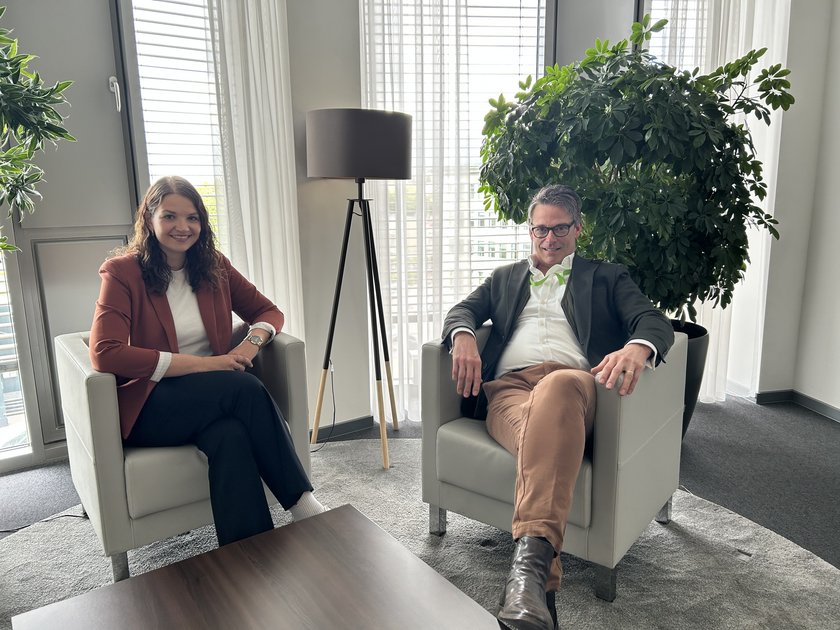
The shortage of skilled workers is particularly acute in elder care. In your view, what are the main causes of the shortage of skilled workers in elder care?
Julia Glöggler: The shortage of skilled workers is the result of several trends that have developed over the years. For one thing, demographic change is causing a significant increase in the number of people in need of care. At the same time, too few young people are choosing careers in nursing, or they do not stay in the field long enough. Added to this is the high level of physical and emotional strain involved in day-to-day work. Furthermore, society’s perception of the nursing profession has long failed to reflect the appreciation this work deserves.
Christopher Nolde: It’s just like the asparagus harvest right now—even though caregiving now pays top dollar. We’re finding it increasingly difficult to fill demanding jobs in Germany. Demand is growing faster than the supply of qualified personnel. At the same time, we’re competing—both nationally and internationally—for well-trained specialists. This increases the pressure to develop genuine long-term strategies for training, retention, and recruitment. It really is a great profession, full of fulfillment and joy!
How do working conditions and management culture compare to salary and career prospects in terms of employee retention?
Julia Glöggler: Working conditions and management culture are key factors in day-to-day job satisfaction. Reliable work schedules, sufficient time for personal care, and a supportive team environment have a direct impact on whether employees enjoy coming to work.
Christopher Nolde: Everything has to be right—our jobs shape our lives. The pay, of course, but also a positive corporate culture, fair leadership, opportunities for personal growth, and stability. People want prospects. We spend more time at work than anywhere else, so expectations are high. I completely understand that.
What innovative approaches do you see for retaining nursing staff in the long term, especially given that the average age of nursing staff is rising?
Julia Glöggler: One important approach is to be more responsive to individual life circumstances. Flexible work schedules and part-time options can help ensure that employees remain in the profession over the long term. In addition, mental health services, coaching, and supervision are becoming increasingly important. Equally important are clear career paths that enable employees to actively shape their professional futures.
Christopher Nolde: For us, innovation means breaking free from old structures from time to time. This includes modern, flat team structures with a high degree of personal responsibility—and, of course, digital support wherever possible. Reducing administrative tasks and spending more time with residents—that’s what creates the satisfaction that matters most, and sometimes that little bit of happiness that explains why we work in care rather than at VW, Amazon, or the cheese counter.
Digitalization and AI are transforming nearly every industry. How can digitalization and AI help ease the burden on caregivers without compromising the quality of human care?
Julia Glöggler: Digital solutions can simplify administrative tasks in particular, such as documentation or shift scheduling. When these processes become more efficient, there is more time for direct care of residents. That is precisely the essence of caregiving.
Christopher Nolde: Technology in healthcare must free up time for bedside care by streamlining necessary administrative and monitoring processes, and, where appropriate, quickly suggesting appropriate treatments based on specific clinical presentations or identifying patterns that require a systematic approach.
In your view, what role does international recruitment play?
Julia Glöggler: International professionals are an important part of the healthcare market. There is certainly no shortage of interested candidates. However, it is crucial that integration be approached holistically—linguistically, professionally, and culturally. Only when people feel welcome can a long-term commitment develop.
Christopher Nolde: International recruitment is more important than ever; we simply can’t do without it. Nevertheless, we must not neglect domestic training—the two must go hand in hand.
What gives you confidence in the future of nursing?
Julia Glöggler: I see a lot of commitment and a willingness to change—both among providers and among the employees themselves. If we manage to further improve working conditions and take individual needs more into account, nursing will remain an attractive profession in the long term.
Christopher Nolde: Nursing is a very special profession that will always attract special people. I’m not worried about that. All it takes is a little professionalism and a cheerful attitude.
Thank you very much for the interview!
The content and statements presented in the interviews reflect the perspectives of the interviewees and do not necessarily reflect the editorial staff’s position.


