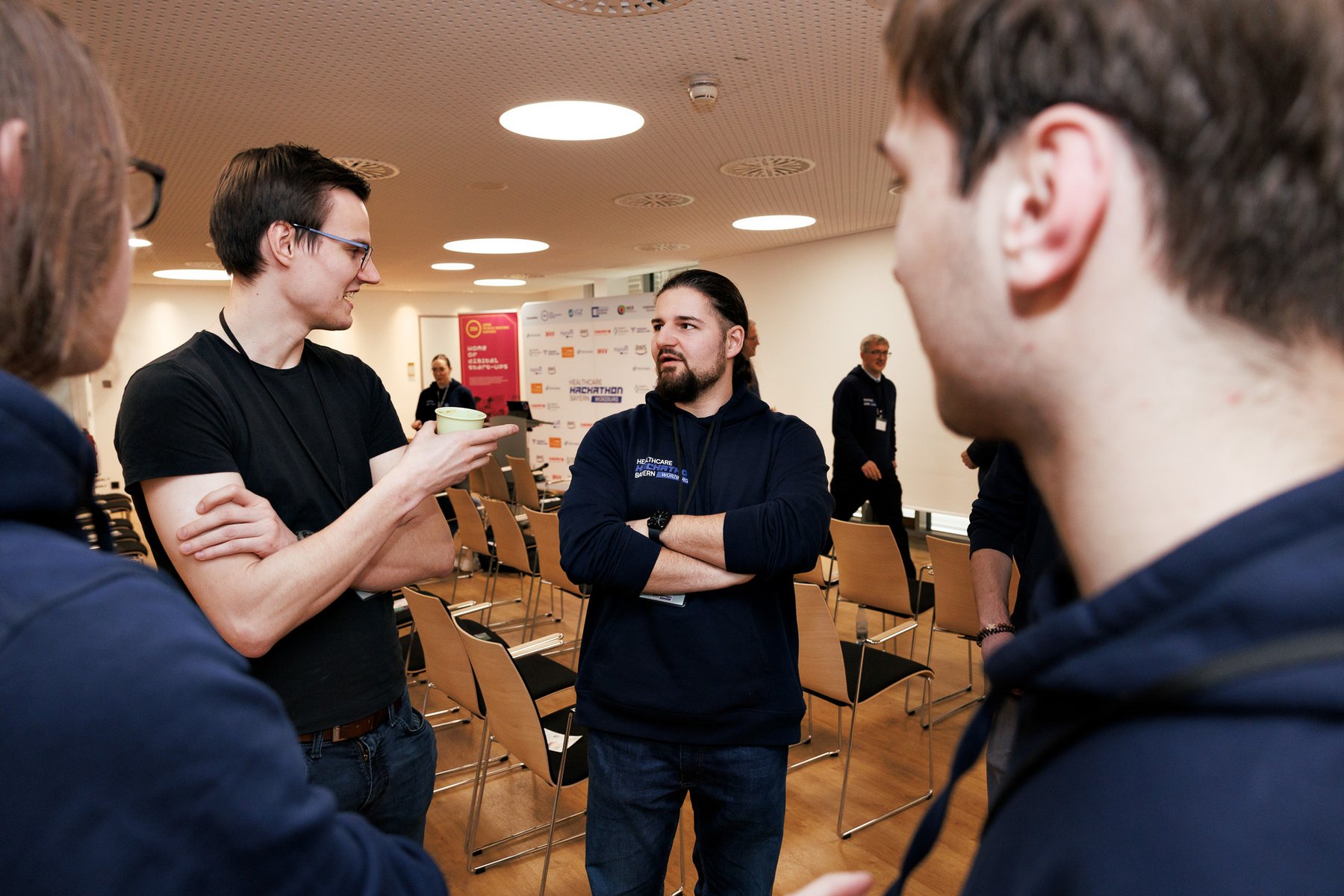
In total, the participants took on nine different challenges covering a broad spectrum of current issues in the healthcare sector: The topics ranged from AR-supported patient training to digital aftercare and early detection apps. For example, one of the tasks addressed the automatic creation of detailed surgical reports and their visualization through speech analysis - an example of how artificial intelligence could relieve the burden on everyday hospital life in the future.
In interdisciplinary teams, the participants developed innovative digital solutions for these tasks - with success: first place went to Team TRIAS with an AI search function for health documents, followed by Code&Care with digital aftercare for children following intensive care treatment. The SYSTHEMISts took third place with an AI-based documentation solution for surgical procedures.
“Every line of code can be a small step towards a better healthcare system”
For the HNU team, supporting the HealthCare Hackathon was a special expression of their commitment to practical research. “Every line of code can be a small step towards a better healthcare system,” says Prof. Dr. Johannes Schobel, who himself conducts research in the field of digital medicine and care at HNU's DigiHealth Institute. Institute colleague Daniel Hieber, who is currently doing his doctorate on machine learning and digitalization in neuropathology, also supported the hackers as a mentor out of conviction: "It was inspiring to see how much curiosity and creativity the participants approached the challenges in the healthcare system. As a mentor, it was important for me to provide impetus and discover new perspectives together with the teams."
The second HealthCare Hackathon Würzburg was organized by the Center for Digital Innovations Mainfranken (opens in a new window) (ZDI) together with the IGZ Würzburg, (opens in a new window) the Institute for Clinical Epidemiology and Biometry (opens in a new window) (IKE-B), the University Hospital Würzburg (opens in a new window) and the Julius-Maximilians-Universität Würzburg (opens in a new window).
Ansprechparter
Prof. Dr. Johannes Schobel
Daniel Hieber