
Leonie Schiller
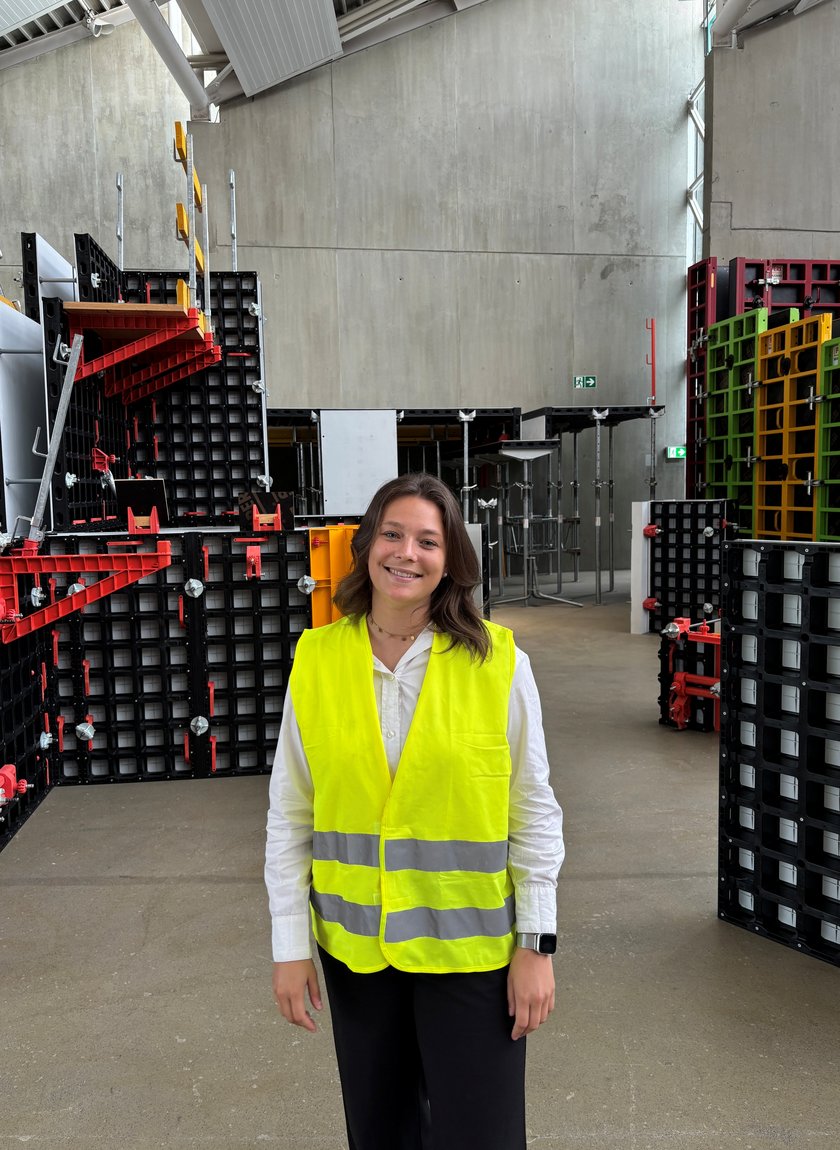
Study programmes: Digital Business Management (BA) at DHBW Heidenheim / Digital Transformation and Global Entrepreneurship (MSc) (opens in a new window)
Employer: Vemaventuri GmbH (a subsidiary of PERI SE)
Position: Specialist Customer Experience and Marketing
What made you decide to study at HNU?
The location (in Ulm, around Ulm, and all over Ulm :)) offers a real advantage: here, you have direct access to many major industrial companies, and HNU is renowned precisely for this – namely for making the most of this proximity and offering a wealth of practice-oriented projects in collaboration with these companies. And for anyone wanting to specialise in innovation, entrepreneurship or digital transformation at Master’s level, you’ll struggle to find more interesting degree programmes than those at HNU. That’s what made the difference for me.
What advice would you give to students on your degree programme?
My number one piece of advice: start building connections with companies as early as you can. DTE genuinely sets you up well for this, since the programme is built around hands-on experience through case studies, workshops, and industry collaborations. Take full advantage of those opportunities, and once they are over, keep the relationships alive. Pursue internships, working student positions, and grow your network intentionally. It is one of the most powerful things you can do for your career.
What was your first job like, and how did you come across it?
My current job is my first job. I work at Vemaventuri, a corporate spin-off of PERI SE. We build sensor solutions for construction sites and, being a young company, we still operate with a lot of agility and a real appetite for experimentation. It is a great fit for me personally, because I get to live out exactly the combination of digital transformation and entrepreneurial thinking that drew me to my studies in the first place.
My title is Specialist Customer Experience & Marketing. It is in the Customer Experience space especially where I feel the impact of my DTE degree most strongly. I developed a genuine ability to think from the customer's perspective and to look beyond my own industry for inspiration: What are other companies getting right? Which best practices could we adapt for our own customer processes? Those are questions I ask myself every single day.
Please describe your typical working day. What projects are you working on, and which tasks do you particularly enjoy?
At a young spin-off like ours, there is no such thing as a fixed job description. My days are varied and span a wide range of areas:
Customer Experience: shaping customer and support processes, managing the customer journey, and leading onboarding initiatives.
- Sales: contributing to projects around lead generation and market validation.
- Marketing: running performance marketing campaigns, representing the company at trade fairs, and supporting product launches.
- When the situation calls for it, I even help out in the warehouse. For me, that variety is a huge plus since there is always something new to learn.
There are real challenges too. Our products are highly technical, and I sometimes feel the gap left by not having a civil engineering background. That said, genuine curiosity goes a long way, and you pick things up faster than you might expect. It just reinforces how important it is to truly believe in what your company builds. On top of that, making your mark as a young woman in a construction industry that is still heavily male-dominated takes confidence and persistence. But it is absolutely doable.
Which aspects of your studies at HNU have proved valuable in your professional life?
We covered a lot of frameworks during our studies, and I often wondered whether I would actually use them in the real world. The honest answer is: not step by step, but as a source of orientation and structure, they are incredibly valuable. When I kick off a new project or plan a workshop, I still find myself pulling up the Design Thinking or Digital Transformation frameworks from Professor Schallmo. Not to follow them to the letter, but to have a solid mental scaffold for how to tackle the problem. That alone makes them worth it.
Something else that genuinely surprised me is how frequently I rely on academic research methods. In my Customer Experience role, working with customer feedback is a big part of my job, and at some point it clicked: this is basically qualitative research. Since then I have been applying the same methods I learned for writing academic papers to the way I collect, organise, and analyse customer insights.
The takeaway is that you do not need to apply everything literally. The frameworks and methods you pick up during your studies become a toolkit you keep reaching for, often in ways you never expected.
To round off, could you tell us about your participation in the ISPIM conference in Granada 2026:
This year, my two friends and I had the chance to present our research paper at the ISPIM Conference in Granada, one of the most renowned innovation management conferences out there, bringing together people from academia and industry practice.
All three of us work at PERI, which is what led us to write a paper on the construction industry. PERI sponsored our trip, which made the whole thing possible. What made the conference so exciting was the mix of people: researchers and practitioners from all kinds of industries and roles, all in one place. Since each of us comes from a different background (HR, Innovation Research & Customer Experience), we all had our own conversations and takeaways. It is the kind of event where every perspective adds something.
None of it would have happened without Dr. Williams' course at HNU. The qualitative paper we wrote there was the one that got accepted, and since it was our first conference, having his support throughout the whole preparation process was invaluable.
The highlight was of course presenting our research on the main stage. Thanks to the countless presentations we gave throughout our master's program, we were able to deliver with real confidence and quality. It just goes to show how much the skills you build along the way really do pay off.
One of our biggest takeaways was a reminder that innovation rarely happens in a bubble. Talking to people from completely different industries showed us how much is already out there that could be adapted and applied elsewhere. One example that stuck with us: technology originally developed to protect soldiers from landmine injuries was later adapted for child safety seats. That kind of cross-industry thinking is something we actually trained a lot in Prof. Schallmo's courses, where we were always encouraged to look beyond our own industry for best practices rather than just benchmarking within it. The conference brought that lesson to life in a very real way.
How would you finish the following sentence?
HNU… “not only equipped me with the skills I needed for my career, but also showed me just how closely theory and practice can be linked.”


