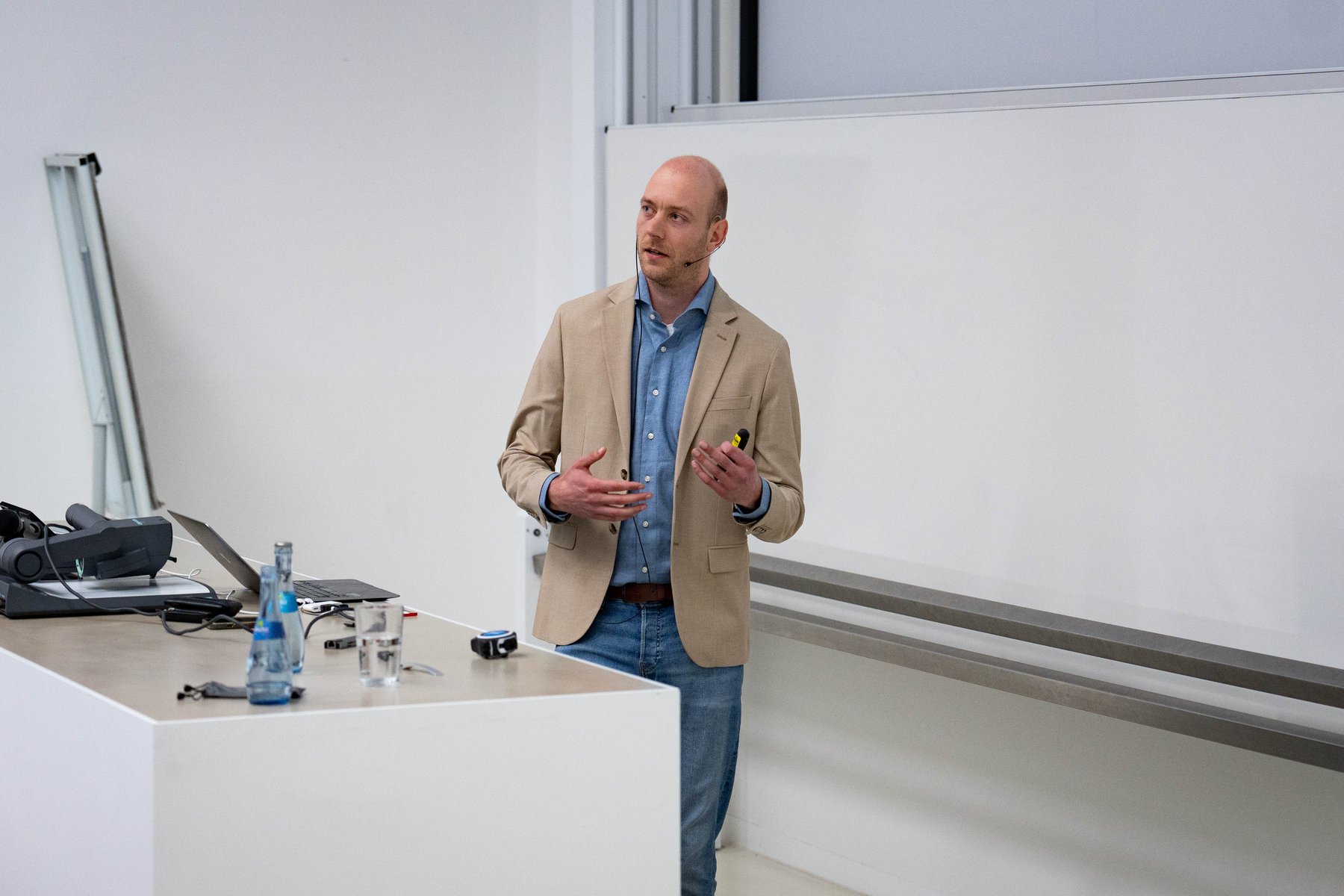
Dr. Marvin Neumann earned his doctorate in Groningen and conducted research in Minnesota (USA), among other places. Since 2023, he has been a junior professor of organizational psychology at Vrije Universiteit Amsterdam. His academic interests focus on decision-making in the context of personnel selection; his practical research addresses in particular the improvement of decision-making processes through (simple) algorithms. He publishes regularly and advises organizations and companies such as the Dutch Ministry of Defense, the police, and Bosch.
His presentation at the Management Forum was entitled “How can simple algorithms and intuition improve decisions?” He was welcomed by Vice President Prof. Dr. Jens Kolb, and Prof. Dr. Johannes Basch introduced him.
Simple algorithms versus intuition – which provides better advice?
Algorithms do not have to be complicated, emphasized Dr. Marvin Neumann right at the start of his presentation. His research focuses on decision-making rules that aim to reduce perceived complexity and direct attention to the core issue: the combination of information. This can be done holistically – and thus more intuitively – or algorithmically. While humans often combine information “from the gut” (holistic combination), algorithms follow fixed, consistent rules (algorithmic combination). The empirical evidence is clear: algorithms beat human intuition.
Bias and noise: an interactive approach
The expert explained that one key reason for this lies in the reduction of bias and noise, two phenomena in decision-making that he illustrated to the audience using a tape measure experiment. The small on-site experiment confirmed that people are not only subject to cognitive distortions (bias), but also make inconsistent judgments (noise), both in comparison to others and to themselves at different points in time. Algorithms eliminate these undesirable effects and are therefore significantly more reliable than human expert judgments. Particularly interesting for personnel selection: according to Dr. Neumann, HR experts do not automatically make better intuitive decisions than laypeople. Rather, the former tend to process information in a complex manner. An abundance of information also tends to lead to greater complexity rather than necessarily better decisions. The decisive factor is therefore not so much individual experience or the wealth of data, but rather the structure of the decision-making process.
Autonomy as one of the biggest hurdles in dealing with algorithmic decision-making
As unanimous as the research is, algorithmic decisions remain unpopular in practice. Holistic decision-making enjoys significantly higher acceptance—an effect that was already proven in the 1980s and is also evident in current studies. This is precisely where the speaker's research comes in: How can decision-making processes be designed that are both accurate and accepted?
Dr. Neumann identified the need for autonomy as a key hurdle and, at the same time, a possible lever: People need to feel that they have an influence on decisions. Simply having the opportunity to contribute their own assessments as input or to justify deviations increases both acceptance and decision quality. Based on several studies, the speaker highlighted the extent to which hybrid models, in which people could design or influence an algorithm themselves, were more successful than a purely holistic approach.
“Practice algorithmic decision-making”
The conclusion for practical application was clear: algorithmic decision-making should be used, not least because it makes processes more accurate, transparent, faster, and cost-effective. “Practice algorithmic decision-making,” recommends the decision researcher. “You will still make mistakes—but relatively speaking, fewer of them.”
Discussion with the audience: Autonomy, responsibility, and power
The presentation led to a lively discussion about pragmatic and ethical questions surrounding algorithmic decisions. One thing became particularly clear: The greatest challenge often lies less in technical implementation than in psychological acceptance.
About the HNU Management Forum
The HNU regularly invites business leaders to the HNU Management Forum to report on current, practical topics from various areas of corporate management and share their valuable wealth of experience.
Contact
Prof. Dr. Jens Kolb