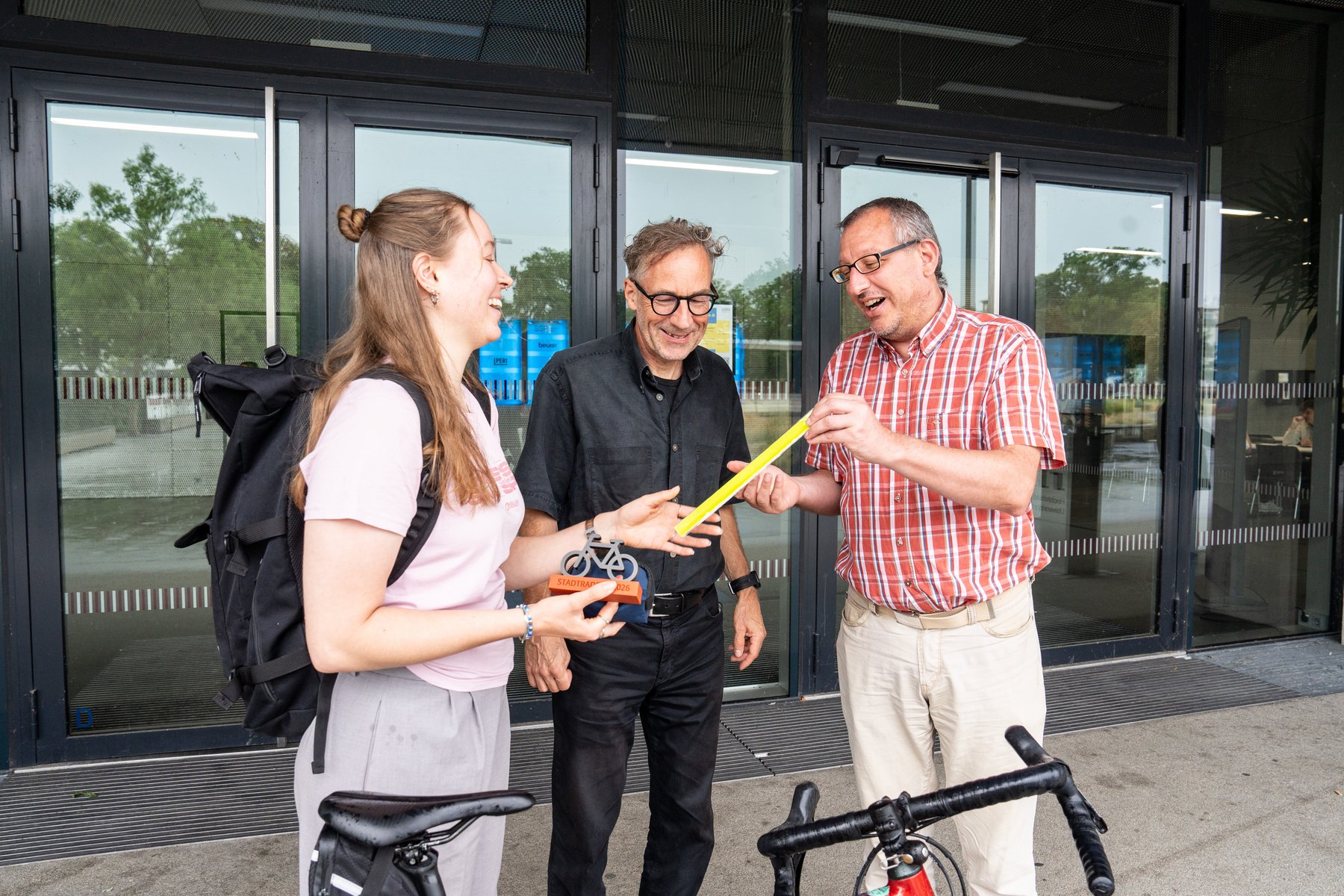
With 23 active cyclists, 5,145 kilometres cycled and 488 journeys, the HNU team achieved an outstanding 9th place in the city rankings. By switching to cycling, around 844 kilograms of CO₂ emissions were avoided.
Outstanding individual performance
Swantje Giencke played a particularly significant part in this success. Having cycled 702.5 kilometres across 77 journeys, she was the HNU’s most active cyclist, preventing 115.2 kilograms of CO₂ emissions in the process. For this impressive achievement, as the top-ranked member of the university team, she received a trophy and a small gift in recognition of her sporting and sustainable commitment. Jürgen Lentschig, Head of Facilities Management and Health and Safety, and HNU Chancellor Marcus Dingel presented her with a 3D-printed trophy.
A strong team effort
The result is a remarkable collective achievement that demonstrates just how important sustainable mobility is to the university community. Every kilometre cycled helps to reduce emissions and promote cycling as part of everyday life. The high level of motivation and commitment shown by all participants played a key role in this success.
Achieving more together
The fact that the university has been ranked in the top 10 in the city of Neu-Ulm underlines that sustainable mobility is actively practised at HNU. Having cycled more than 5,000 kilometres and achieved a significant reduction in CO₂ emissions, the university team has made a valuable contribution to climate protection and demonstrated that collective commitment can make a real difference.