
Geothermal Energy Dialogue
Geothermal energy is regarded as a key component of the energy transition – yet many people lack knowledge about the technology and its potential. Robin Renoth addressed the question of how this knowledge can be communicated in an accessible way in his project “Dialog Geothermie”: he guided students in bringing science directly into the public sphere and making deep geothermal energy tangible and understandable through personal interaction. Here, the HNU PhD student explains why science communication is so important to him.

Nominated for the Bavarian-Swabian
Innovation Award Transfer 2026 of Neu-Ulm University of Applied Sciences
What is it all about?
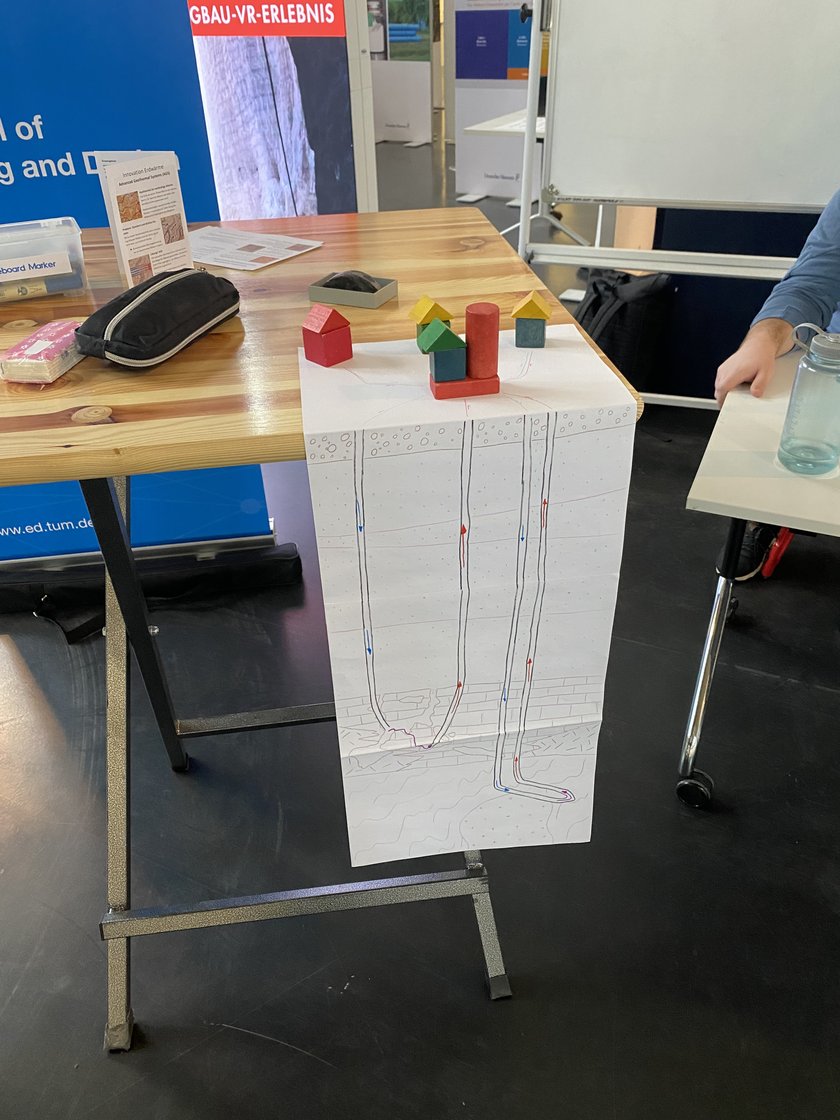
The “Geothermal Energy Dialogue” project, which Robin Renoth supervised as part of his academic training, was part of a course on public participation and energy infrastructure at the Technical University of Munich (TUM). The focus was on direct dialogue between students and the public: At two information stands in the Science Communication Lab at the Deutsches Museum, students explained complex topics relating to deep geothermal energy to visitors with no specialist background in a way that was easy to understand, practical and dialogue-based. The information stands were presented on 9 January 2026 and covered both the fundamentals of geothermal energy and two innovative technological approaches: Enhanced Geothermal Systems (EGS) and Advanced Geothermal Systems (AGS). Whilst EGS involves the targeted development of the subsurface to enable an open heat cycle, AGS is based on a closed heat cycle deep underground. The aim of the project was to present the latest research in an accessible way and to actively promote dialogue on sustainable energy and heating technologies.
Robin Renoth

He carried out the project as part of a course on public participation.
The project brings together all three dimensions of sustainability: direct engagement between students and the public helps to increase acceptance of sustainable energy and heating solutions. The project also makes an environmental contribution by making geothermal energy – a low-emission technology capable of providing base load power – a more tangible part of the energy transition. Furthermore, involving the public at an early stage and ensuring they are well-informed can, in the long term, help to make planning processes more efficient and reduce conflicts surrounding infrastructure projects.
The cooperation partner
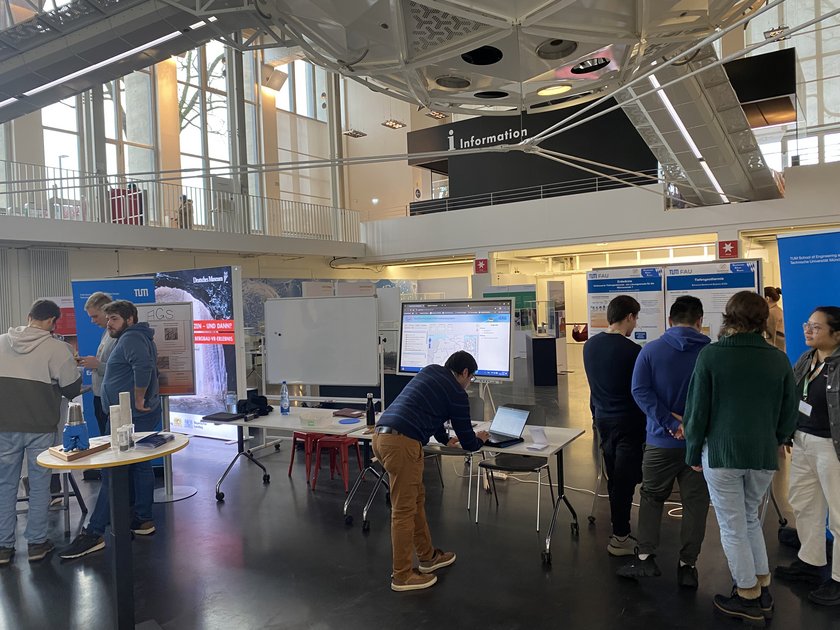
As part of Robin Renoth’s collaborative PhD programme, the latest research findings in the field of geothermal energy were directly integrated into the teaching programme and made available for public discussion. The Deutsches Museum acted as the key industry partner in this initiative: At the Science Communication Lab there, students were able to test the dialogue and engagement formats they had developed directly with visitors and gain experience outside the university setting.
The close collaboration between HNU, TUM and the Deutsches Museum was unique in its form and, by combining specialist knowledge, practical relevance and science communication, gave rise to an innovative approach to the transfer of knowledge to society.
Interview with Robin Renoth
[1] How would you describe your project in three key words?
Science – Encounter – Society
[2] What is special about your project?
What makes our project special is that students do not merely study academic content in seminars, but also communicate it directly to the public.
‘Dialog Geothermie’ presents complex knowledge about geothermal energy as a source of power, as well as about innovative geothermal technologies, in an accessible and easy-to-understand way. It is an unfamiliar experience for students to translate their specialist knowledge into a simple, accessible format for people without a technical background. This creates a space where everyone – whether a layperson or an expert – can ask questions, join in the discussion and form their own opinion.
What is particularly valuable here is that the transfer of knowledge works both ways:
- Visitors gain an accessible introduction to a topic of the future that has a direct connection to their everyday lives through heating supply and the heating transition.
- Students learn how science is perceived outside the university context and how challenging, yet important, it is to communicate complex ideas in an accessible way.
This ensures that the result is not a one-sided, monotonous lecture, but a genuine dialogue between equals from which everyone involved benefits.
In my view, it is precisely this combination of research, teaching and social interaction that makes the project so wonderful and unique. Here, science does not remain abstract; instead, a practical link to everyday life is established. ‘Dialog Geothermie’ thus creates an accessible point of entry in the public sphere, offering genuine added value both to today’s society and to the specialists of tomorrow.
[3] What does transfer mean to you?
For me, knowledge transfer means not confining scientific findings to the university environment, but conveying them to society in a way that is understandable, accessible and relevant. At the same time, I believe that successful knowledge transfer thrives on mutual exchange: the questions, perspectives and expectations of the public are incorporated into research and teaching in the process. This mutuality enables all those involved to develop further and helps society to better understand research and teaching. At the same time, this opens up the opportunity to further develop transfer projects such as ‘Dialog Geothermie’ in a practical manner, drawing on the newly gained experience and feedback.
[4] What do you take away from the project - professionally, but also personally?
From a professional perspective, what I have taken away from the project is that the ability to communicate complex scientific content in an accessible way is a key skill. It is not enough simply to possess specialist knowledge – what matters is presenting it in such a way that different target groups can engage with it. It was the direct exchange of views, in particular, that highlighted just how different scientific perspectives and public perception can be. The students’ varied approaches to explaining and communicating knowledge, as well as the wide-ranging questions posed by visitors, have shown me that knowledge transfer is a highly dynamic field that can be further developed through outreach projects such as ‘Dialog Geothermie’. A successful outreach project thrives on exchange, thereby creating added value for all those involved: society, teaching and research.
Personally, I have learnt just how valuable it is to engage with people on an equal footing. The project has shown me once again that effective science communication is not just about explaining, but also about listening. This exchange broadens one’s own perspective and fosters a better understanding of how research and specialist knowledge can have a positive impact on society. For me, the key takeaway is that science is at its most powerful when it becomes accessible, reaches people and can be explored further through dialogue.


