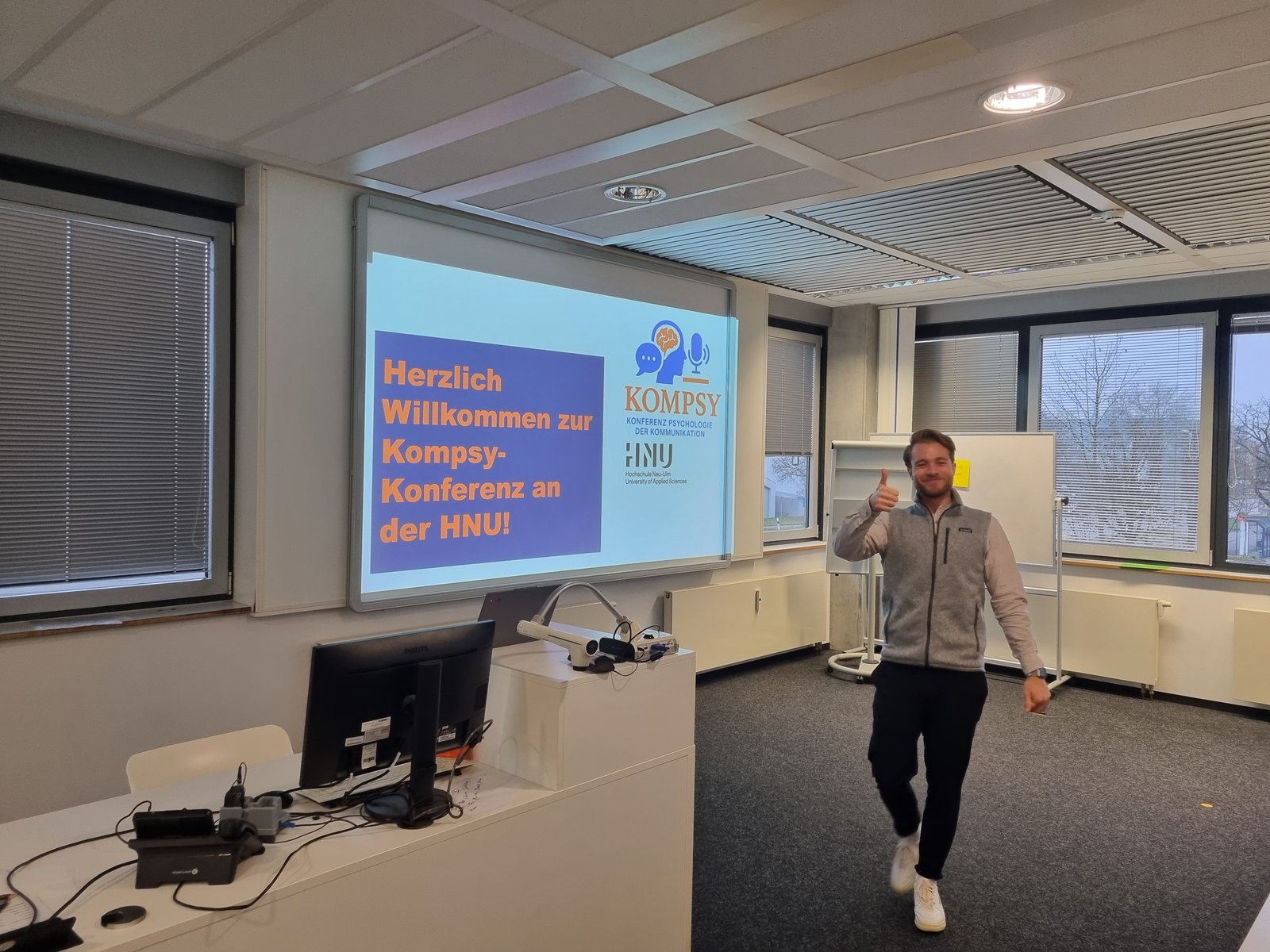
The didactic idea behind the format was to create an innovative approach to theoretical knowledge. KomPsy built on previous teaching content: in other courses in the module, students had already worked intensively on rhetoric, presentation techniques and their own presentation skills, including video feedback. Now they were able to apply these skills in a practical setting and translate them into the context of an academic conference.
Eight symposia on theoretical depth
Divided into eight symposia, each covering a subfield of communication psychology, the students presented up to six current empirical research papers on behalf of the respective authors. The content ranged from linguistic and non-verbal aspects of communication to relationship dynamics and digital forms of communication: How do accents, dialects or speech impediments influence our perception of people? What role do Zoom fatigue, emojis or eye contact play in digital contexts? And can deception in communication actually be recognised?
The linchpin of KomPsy: student responsibility
A central element of the concept was the independent organisation of the symposia by the students. They decided for themselves on the technical procedures and possible presentation and exchange formats, and took on active roles in time management and discussion leadership. In this way, the format not only imparted specialist knowledge, but also provided a realistic idea of the procedures involved in scientific conferences – including conference dinners and coffee breaks.
Skills in science communication: not only helpful for aspiring researchers
The teeching format thus offers students considerable added value for their future professional lives on several levels: On the one hand, the insight into academic arenas pays off for students who want to pursue their own scientific careers. Those who stand out through commitment and initiative often get the chance to actively participate in conferences while still studying. On the other hand, the conference simulation strengthens transfer and presentation skills, which also play an important role for students with non-academic career aspirations.
Conference highlight: Keynote speech by Dr Wassiliwzky
A particular highlight of the event was the keynote speech by Dr Eugen Wassiliwizky, who conducts research at the Max Planck Institute for Empirical Aesthetics in Frankfurt am Main. In his presentation, he provided insights into his current research on the perception of attractiveness and the so-called gender attractiveness gap. In addition, several of his scientific papers on the development of goosebumps in art perception were part of the student symposia.
Positive response: The ‘KomPsy’ is to be followed by further student conferences
In particular, the continuous classification of events in comparison to “real” conferences contributed to the transparency and depth of the event. The unusual teaching format proved to be a viable framework for the seminar and also stimulated professional exchange. Prof. Dr Johannes Basch emphasises that it was particularly important to him not only to formally replicate the conference format, but also to make it a tangible experience as a common working framework. With success: ‘The students participated in all discussions with full attention and depth of content – despite the usually very busy pre-Christmas period. In my view, this speaks for the quality of the presentations, and I would have trusted each and every one of them to present at a real psychological conference.’
KomPsy demonstrates how innovative teaching concepts can effectively combine specialist content and practical relevance and strengthen students' skills in the field of science communication – an approach with a promising future that should be continued.
Contact
Prof. Dr. Johannes Basch